Thursday, September 1, 2016

Russia Plans Mission to Land a Rocket on Jupiter's Ganymede, Only Moon with its Own Magnetic Field --"100-Kilometer-Deep Ocean a Hotspot for Life"


In a video uploaded to YouTube on August 3rd (below), engineers from the Russian space agency, Roscosmos, proposed an orbiter and lander mission to Ganymede. The video suggests a launch could come in the next decade. Although the commentary is in Russian, the video appears to suggest that Ganymede may be as good a candidate or better  for life than Europa.
In March of 2015, NASA's Hubble Space Telescope revealed the best evidence yet for an underground saltwater ocean on Ganymede, Jupiter's largest moon. The subterranean ocean is thought to have more water than all the water on Earth's surface. Identifying liquid water is crucial in the search for habitable worlds beyond Earth and for the search for life, as we know it.
"This discovery marks a significant milestone, highlighting what only Hubble can accomplish," said John Grunsfeld, recently retired assistant administrator of NASA's Science Mission Directorate at NASA Headquarters. "In its 25 years in orbit, Hubble has made many scientific discoveries in our own solar system. A deep ocean under the icy crust of Ganymede opens up further exciting possibilities for life beyond Earth."

 Ganymede is the largest moon in our solar system and the only moon with its own magnetic field, shown above. The magnetic field causes aurorae, which are ribbons of glowing, hot electrified gas, in regions circling the north and south poles of the moon. Because Ganymede is close to Jupiter, it is also embedded in Jupiter's magnetic field. When Jupiter's magnetic field changes, the aurorae on Ganymede also change, "rocking" back and forth.

By watching the rocking motion of the two aurorae, scientists were able to determine that a large amount of saltwater exists beneath Ganymede's crust, affecting its magnetic field.
A team of scientists led by Joachim Saur of the University of Cologne in Germany came up with the idea of using Hubble to learn more about the inside of the moon. "I was always brainstorming how we could use a telescope in other ways," said Saur. "Is there a way you could use a telescope to look inside a planetary body? Then I thought, the aurorae! Because aurorae are controlled by the magnetic field, if you observe the aurorae in an appropriate way, you learn something about the magnetic field. If you know the magnetic field, then you know something about the moon's interior."
If a saltwater ocean were present, Jupiter's magnetic field would create a secondary magnetic field in the ocean that would counter Jupiter's field. This "magnetic friction" would suppress the rocking of the aurorae. This ocean fights Jupiter's magnetic field so strongly that it reduces the rocking of the aurorae to 2 degrees, instead of 6 degrees if the ocean were not present. Scientists estimate the ocean is 60 miles (100 kilometers) thick -- 10 times deeper than Earth's oceans -- and is buried under a 95-mile (150-kilometer) crust of mostly ice.


 Scientists first suspected an ocean in Ganymede in the 1970s, based on models of the large moon. NASA's Galileo mission measured Ganymede's magnetic field in 2002, providing the first evidence supporting those suspicions. The Galileo spacecraft took brief "snapshot" measurements of the magnetic field in 20-minute intervals, but its observations were too brief to distinctly catch the cyclical rocking of the ocean's secondary magnetic field.
The new observations were done in ultraviolet light and could only be accomplished with a space telescope high above Earth's atmosphere, which blocks most ultraviolet light.

NASA's First Encounters with Planets in the Solar System

Earthrise
Apollo 8, the first manned mission to the moon, entered lunar orbit on Christmas Eve, Dec. 24, 1968. That evening, the astronauts-Commander Frank Borman, Command Module Pilot Jim Lovell, and Lunar Module Pilot William Anders-held a live broadcast from lunar orbit, in which they showed pictures of the Earth and moon as seen from their spacecraft. Said Lovell, "The vast loneliness is awe-inspiring and it makes you realize just what you have back there on Earth." They ended the broadcast with the crew taking turns reading from the book of Genesis.

Image Credit: NASA

 Voyager 2 Image of Neptune

This picture of Neptune was produced from the last whole planet images taken through the green and orange filters on the Voyager 2 narrow angle camera. The images were taken at a range of 4.4 million miles from the planet, 4 days and 20 hours before closest approach. The picture shows the Great Dark Spot and its companion bright smudge; on the west limb the fast moving bright feature called Scooter and the little dark spot are visible. These clouds were seen to persist for as long as Voyager's cameras could resolve them. North of these, a bright cloud band similar to the south polar streak may be seen.

Image Credit: NASA/JPL


 Voyager 1 Image of Saturn

Voyager 1 looked back at Saturn on Nov. 16, 1980, four days after the spacecraft flew past the planet, to observe the appearance of Saturn and its rings from this unique perspective. A few of the spokelike ring features discovered by Voyager appear in the rings as bright patches in this image, taken at a distance of 5.3 million kilometers (3.3 million miles) from the planet. Saturn's shadow falls upon the rings, and the bright Saturn crescent is seen through all but the densest portion of the rings. From Saturn, Voyager 1 is on a trajectory taking the spacecraft out of the ecliptic plane, away from the Sun and eventually out of the solar system (by about 1990). Although its mission to Jupiter and Saturn is nearly over (the Saturn encounter ends Dec. 18, 1980), Voyager 1 will be tracked by the Deep Space Network as far as possible in an effort to determine where the influence of the Sun ends and interstellar space begins. Voyager 1's flight path through interstellar space is in the direction of the constellation Ophiuchus. Voyager 2 will reach Saturn on August 25, 1981, and is targeted to encounter Uranus in 1986 and possibly Neptune in 1989. The Voyager project is managed for NASA by the Jet Propulsion Laboratory, Pasadena, California.

Image Credt: NASA/JPL


Voyager 1 Image of Jupiter

First close-up view of Jupiter from Voyager 1.

Voyager 1's closest approach to Jupiter occurred March 5, 1979.

Image Credit: NASA
 
 Mariner 10 Image of Mercury

Mercury: Computer Photomosaic of the Southern Hemisphere

The Image Processing Lab at NASA's Jet Propulsion Laboratory produced this photomosaic using computer software and techniques developed for use in processing planetary data. The Mariner 10 spacecraft imaged the region during its initial flyby of the planet.

The Mariner 10 spacecraft was launched in 1974. The spacecraft took images of Venus in February 1974 on the way to three encounters with Mercury in March and September 1974 and March 1975. The spacecraft took more than 7,000 images of Mercury, Venus, the Earth and the Moon during its mission.

The Mariner 10 Mission was managed by the Jet Propulsion Laboratory for NASA's Office of Space Science in Washington, D.C.

Image Credit: NASA/JLP
 
 
Mariner 4 Image of Mars

After an eight-month voyage to Mars, Mariner 4 makes the first flyby of the red planet, becoming the first spacecraft to take close-up photographs of another planet. The images show lunar-type impact craters, some of them touched with frost in the chill Martian evening. A television camera onboard takes 22 pictures, covering about 1% of the planet. Initially stored on a 4-track tape recorder, these pictures take four days to transmit back to Earth.

On July 15, 1965, Mariner 4 transmitted this image of the Martian surface from 7,829 miles away. The photograph shows a 94-mile diameter crater.

Although originally not expected to survive much past the Mars flyby encounter, Mariner 4 lasts about three years in solar orbit, continuing long-term studies of the solar wind environment and making coordinated measurements with Mariner 5, a sister ship launched to Venus in 1967.

Image Credit: NASA/JPL
 
 Mariner 10's First Close-Up Photo of Venus

On Feb. 5, 1974, NASA's Mariner 10 mission took this first close-up photo of Venus.

Made using an ultraviolet filter in its imaging system, the photo has been color-enhanced to bring out Venus's cloudy atmosphere as the human eye would see it. Venus is perpetually blanketed by a thick veil of clouds high in carbon dioxide and its surface temperature approaches 900 degrees Fahrenheit.

Launched on Nov. 3, 1973 atop an Atlas-Centaur rocket, Mariner 10 flew by Venus in 1974.

Image Credit: NASA
 
 This color version of the July 3 LORRI image was created by adding color data from the Ralph instrument gathered earlier in the mission.

Image Credit: NASA/JHUAPL/SWRI

First stars formed even later than previously thought

Cosmic reionisation. Credit: ESA – C. Carreau


ESA's Planck satellite has revealed that the first stars in the Universe started forming later than previous observations of the Cosmic Microwave Background indicated. This new analysis also shows that these stars were the only sources needed to account for reionising atoms in the cosmos, having completed half of this process when the Universe had reached an age of 700 million years. 


With the multitude of stars and galaxies that populate the present Universe, it's hard to imagine how different our 13.8 billion year cosmos was when it was only a few seconds old. At that early phase, it was a hot, dense primordial soup of particles, mostly electrons, protons, neutrinos, and photons – the particles of light.
In such a dense environment the Universe appeared like an 'opaque' fog, as light particles could not travel any significant distance before colliding with electrons.
As the cosmos expanded, the Universe grew cooler and more rarefied and, after about 380 000 years, finally became 'transparent'. By then, particle collisions were extremely sporadic and photons could travel freely across the cosmos.

History of the Universe. Credit: ESA


Today, telescopes like Planck can observe this fossil light across the entire sky as the Cosmic Microwave Background, or CMB. Its distribution on the sky reveals tiny fluctuations that contain a wealth of information about the history, composition and geometry of the Universe.
The release of the CMB happened at the time when electrons and protons joined to form hydrogen atoms. This is the first moment in the history of the cosmos when matter was in an electrically neutral state.
After that, a few hundred million years passed before these atoms could assemble and eventually give rise to the Universe's first generation of stars.
As these first stars came to life, they filled their surroundings with light, which subsequently split neutral atoms apart, turning them back into their constituent particles: electrons and protons. Scientists refer to this as the 'epoch of reionisation'. It did not take long for most material in the Universe to become completely ionised, and – except in a very few, isolated places – it has been like that ever since.
Observations of very distant galaxies hosting supermassive black holes indicate that the Universe had been completely reionised by the time it was about 900 million years old. The starting point of this process, however, is much harder to determine and has been a hotly debated topic in recent years.
"The CMB can tell us when the epoch of reionisation started and, in turn, when the first stars formed in the Universe," explains Jan Tauber, Planck project scientist at ESA.
To make this measurement, scientists exploit the fact that a fraction of the CMB is polarised: part of the light vibrates in a preferred direction. This results from CMB photons bouncing off electrons – something that happened very frequently in the primordial soup, before the CMB was released, and then again later, after reionisation, when light from the first stars brought free electrons back onto the cosmic stage.
"It is in the tiny fluctuations of the CMB polarisation that we can see the influence of the reionisation process and deduce when it began," adds Tauber.

Polarisation of the Cosmic Microwave Background. Credit: ESA and the Planck Collaboration

A first estimate of the epoch of reionisation came in 2003 from NASA's Wilkinson Microwave Anisotropy Probe (WMAP), suggesting that this process might have started early in cosmic history, when the Universe was only a couple of hundred million years old. This result was problematic, because there is no evidence that any stars had formed by then, which would mean postulating the existence of other, exotic sources that could have caused the reionisation at that time.
This first estimate was soon to be corrected, as subsequent data from WMAP pushed the starting time to later epochs, indicating that the Universe had not been significantly reionised until at least some 450 million years into its history.
This eased, but did not completely solve the puzzle: although the earliest of the first stars have been observed to be present already when the Universe was 300 to 400 million years old, it remained unclear whether these stars were the main culprits for reionising fully the cosmos or whether additional, more exotic sources must have played a role too.
In 2015, the Planck Collaboration provided new data to tackle the problem, moving the reionisation epoch even later in cosmic history and revealing that this process was about half-way through when the Universe was around 550 million years old. The result was based on Planck's first all-sky maps of the CMB polarisation, obtained with its Low-Frequency Instrument (LFI).
Now, a new analysis of data from Planck's other detector, the High-Frequency Instrument (HFI), which is more sensitive to this phenomenon than any other so far, shows that reionisation started even later – much later than any previous data have suggested.
"The highly sensitive measurements from HFI have clearly demonstrated that reionisation was a very quick process, starting fairly late in cosmic history and having half-reionised the Universe by the time it was about 700 million years old," says Jean-Loup Puget from Institut d'Astrophysique Spatiale in Orsay, France, principal investigator of Planck's HFI.
"These results are now helping us to model the beginning of the reionisation phase."
"We have also confirmed that no other agents are needed, besides the first stars, to reionise the Universe," adds Matthieu Tristram, a Planck Collaboration scientist at Laboratoire de l'Accélérateur Linéaire in Orsay, France.
The new study locates the formation of the first stars much later than previously thought on the cosmic timeline, suggesting that the first generation of galaxies are well within the observational reach of future astronomical facilities, and possibly even some current ones.
In fact, it is likely that some of the very first galaxies have already been detected with long exposures, such as the Hubble Ultra Deep Field observed with the NASA/ESA Hubble Space Telescope, and it will be easier than expected to catch many more with future observatories such as the NASA/ESA/CSA James Webb Space Telescope.

Notes for Editors

'Planck intermediate results. XLVII. Planck constraints on reionization history' and 'Planck intermediate results. XLVI. Reduction of large-scale systematic effects in HFI polarization maps and estimation of the reionization optical depth' by the Planck Collaboration are published in Astronomy and Astrophysics.

More about Planck

Launched in 2009, Planck was designed to map the sky in nine frequencies using two state-of-the-art instruments: the Low Frequency Instrument (LFI), which includes three frequency bands in the range 30-70 GHz, and the High Frequency Instrument (HFI), which includes six frequency bands in the range 100-857 GHz.
HFI completed its survey in January 2012, while LFI continued to make science observations until 3 October 2013, before being switched off on 19 October 2013. Seven of Planck's nine frequency channels were equipped with polarisation-sensitive detectors.
The Planck Scientific Collaboration consists of all the scientists who have contributed to the development of the mission, and who participate in the scientific exploitation of the data during the proprietary period.
These scientists are members of one or more of four consortia: the LFI Consortium, the HFI Consortium, the DK-Planck Consortium, and ESA's Planck Science Office. The two European-led Planck Data Processing Centres are located in Paris, France and Trieste, Italy.
The LFI consortium is led by N. Mandolesi, Università degli Studi di Ferrara, Italy (deputy PI: M. Bersanelli, Università degli Studi di Milano, Italy), and was responsible for the development and operation of LFI. The HFI consortium is led by J.L. Puget, Institut d'Astrophysique Spatiale in Orsay (CNRS/Université Paris-Sud), France (deputy PI: F. Bouchet, Institut d'Astrophysique de Paris (CNRS/UPMC), France), and was responsible for the development and operation of HFI.

Breathtaking Hubble Images of Supernova Remnant Nebulae


1. A Giant Hubble Mosaic of the Crab Nebula

This is a mosaic image, one of the largest ever taken by NASA's Hubble Space Telescope of the Crab Nebula, a six-light-year-wide expanding remnant of a star's supernova explosion. Japanese and Chinese astronomers recorded this violent event nearly 1,000 years ago in 1054, as did, almost certainly, Native Americans.

Credit: NASA, ESA, J. Hester and A. Loll (Arizona State University)


 2. 30 Doradus: the Effects of Massive Stars in R136

Credit: NASA, ESA,


3. Supernova Shock Wave Paints Cosmic Portrait


Remnants from a star that exploded thousands of years ago created a celestial abstract portrait, as captured in this NASA Hubble Space Telescope image of the Pencil Nebula. Officially known as NGC 2736, the Pencil Nebula is part of the huge Vela supernova remnant, located in the southern constellation Vela. Discovered by Sir John Herschel in the 1840s, the nebula's linear appearance triggered its popular name. The nebula's shape suggests that it is part of the supernova shock wave that recently encountered a region of dense gas. It is this interaction that causes the nebula to glow, appearing like a rippled sheet.

Credit: NASA and The Hubble Heritage Team (STScI/AURA) Acknowledgment: W. Blair (JHU) and D. Malin (David Malin Images)
 
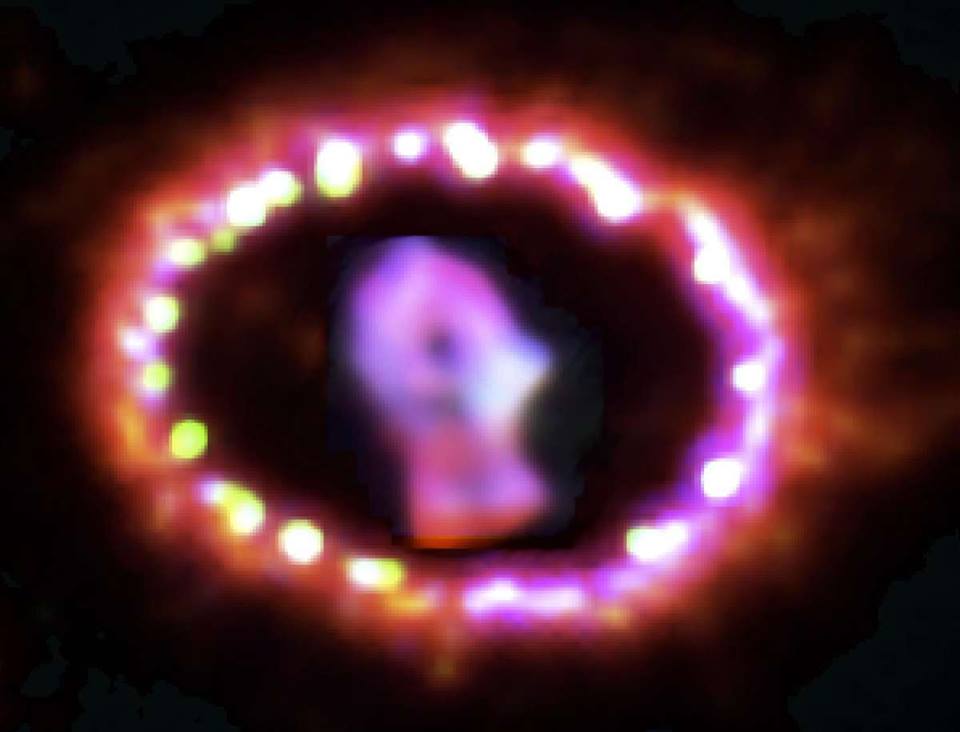
4. Supernova 1987A Debris Disk

Credit: NASA, ESA, and P. Challis (Harvard-Smithsonian Center for Astrophysics)
 
5. Panoramic View of a Turbulent Star-making Region

Several million young stars are vying for attention in this NASA Hubble Space Telescope image of a raucous stellar breeding ground in 30 Doradus, located in the heart of the Tarantula Nebula. Early astronomers nicknamed the nebula because its glowing filaments resemble spider legs.

Credit: NASA, ESA, D.
 
6. Combined X-Ray and Optical Images of the Crab Nebula

A composite image of the Crab Nebula showing the X-ray (blue), and optical (red) images superimposed. The size of the X-ray image is smaller because the higher energy X-ray emitting electrons radiate away their energy more quickly than the lower energy optically emitting electrons as they move.

Credit: NASA/CXC/ASU/J. Hester et al.
7. Veil Nebula - Segment #1

This is a small portion of the Veil Nebula — the shattered remains of a supernova that exploded thousands of years ago. The entire structure spans about 3 degrees on the sky, corresponding to about 6 full moons. The image was taken with Hubble's Wide Field Planetary Camera 2 in November 1994 and August 1997.

Credit: NASA, ESA, and the Hubble Heritage (STScI/AURA)-ESA/Hubble Collaboration

Acknowledgment: J. Hester (Arizona State University)
 
8. Veil Nebula - Segment #2

This is a small portion of the Veil Nebula — the shattered remains of a supernova that exploded thousands of years ago. The entire structure spans about 3 degrees on the sky, corresponding to about 6 full moons. The image was taken with Hubble's Wide Field Planetary Camera 2 in November 1994 and August 1997.

Credit: NASA, ESA, and the Hubble Heritage (STScI/AURA)-ESA/Hubble Collaboration Acknowledgment: J. Hester (Arizona State University)
 
9. 30 Doradus: Hodge 301

Credit: NASA, ESA
 
10. Crab Nebula: a Dead Star Creates Celestial Havoc

Credit: NASA, ESA, CXC, JPL-Caltech, J. Hester and A. Loll (Arizona State Univ.), R. Gehrz (Univ. Minn.), and STScI
 11. 30 Doradus: NGC 2060

Credit: NASA, ESA, D. Lennon and E. Sabbi (ESA/STScI)


12. Tarantula Nebula in the Large Magellanic Cloud

Credit: NASA, ESA, ESO, D. Lennon (ESA/STScI), and the Hubble Heritage Team (STScI/AURA)


13.  Peering into the Heart of the Crab Nebula

In the year 1054 A.D., Chinese astronomers were startled by the appearance of a new star, so bright that it was visible in broad daylight for several weeks. Today, the Crab Nebula is visible at the site of the "Guest Star". Located about 6,500 light-years from Earth, the Crab Nebula is the remnant of a star that began its life with about 10 times the mass of our own Sun. Its life ended on July 4, 1054 when it exploded as a supernova. In this image, NASA's Hubble Space Telescope has zoomed in on the center of the Crab to reveal its structure with unprecedented detail.

Credit: NASA and The Hubble Heritage Team (STScI/AURA)
 
14. Supernova Remnant N 63A Menagerie

When a massive star exploded, spewing out its gaseous layers into a turbulent, star-forming region of the Large Magellanic Cloud, it left behind this chaotic cloud of gas and dust. The star that produced this supernova remnant was probably 50 times the mass of our Sun.

Credit: NASA, ESA, HEIC, and The Hubble Heritage Team (STScI/AURA) Acknowledgment: Y.-H. Chu and R. M. Williams (UIUC)


Greenland may be home to Earth’s oldest fossils

Scientists have found evidence of stromatolites much like these in Shark Bay, Australia within 3.7-billion-year-old rocks from Greenland. Credit: PAUL HARRISON Wikimedia Commons


Geologists say that they have unearthed some of the oldest known evidence for life on Earth. The discovery, yet to be confirmed, suggests that life arose quickly on the young planet.
In this week's Nature, Australian and British researchers report finding layered structures called stromatolites in 3.7-billion-year-old rocks from Greenland. Stromatolites, which look a bit like geological cauliflowers, form when microbes trap sediment and build up layer after dome-shaped layer.
But the discovery involves some of the most physically tortured rocks on Earth, which have been squeezed and heated over billions of years as crustal plates shifted. The pressure and heat recrystallizes the rocks, erasing much of the fine-scale detail that researchers normally use to identify fossilized stromatolites—so the work is already triggering heated debate.
“I’ve got 14 queries and problems that need addressing before I’ll believe it,” says Roger Buick, a geobiologist at the University of Washington in Seattle.
The rocks hail from Isua, Greenland, where researchers have laboured to tease out potential signs of life dating back billions of years. Previous work on the rocks’ chemistry, such as a 1999 paper analysing carbon isotopes, suggested that they contain ‘biomarker’ traces of early organisms. But various claims over the years have remained contentious.

Unearthing evidence

Now, melting snow has revealed new clues. A team led by Allen Nutman, a geologist at the University of Wollongong in Australia, visited a rock outcrop that had been buried under a perennial snow patch until warmer temperatures melted it away. They sawed out a chunk of 3.7-billion-year-old rock and took it back to Australia to study.
In it they found the purported stromatolites, along with other clues to ancient life. “It’s a combination of different types of evidence that makes the story so compelling,” says team member Martin Van Kranendonk, a geologist at the University of New South Wales in Kensington, Australia.
The structures are tiny bumps, just 1–4 centimetres tall, whose shape and internal layering strongly resemble ancient and modern stromatolites, Van Kranendonk and his colleagues say. The texture of the surrounding rocks suggests that they were laid down at the bottom of a shallow sea, much as stromatolites are today in places such as the Bahamas and western Australia. And the rocks contain carbonate minerals such as dolomite, which are also common in younger stromatolites.
The Greenland structures are about 220 million years older than the oldest widely accepted evidence for life, a set of stromatolites from the Pilbara region of western Australia. “The evidence is a whole lot thinner than the rocks in Australia,” says Abigail Allwood, an astrobiologist at NASA’s Jet Propulsion Laboratory in Pasadena, California. “Having said that, it’s incredible that anything can be found in these rocks that are barely a ghost of what they were before. That’s why it’s worthy of attention.”


EARLY START  The wavelike mounds of sediment called stromatolites (marked by dashed lines) embedded inside this cross section of a 3.7-billion-year-old rock may be the oldest known fossilized evidence of life on Earth.

Doubts crystallize

Part of the problem with studying ancient stromatolites is that layered structures can form through processes that have nothing to do with life. Minerals precipitating out on the seafloor can leave layers, like rings on a bathtub, that look like stromatolites but aren't.
“At most, these structures should be classified as pseudostromatolites,” says Kathleen Grey, a consulting palaeontologist in Perth, Australia, who has worked on ancient stromatolites. “Sadly, I don’t feel the evidence is convincing for such an important claim.”
Tanja Bosak, a geobiologist at the Massachusetts Institute of Technology in Cambridge, adds that she would like to see whether the proposed stromatolites have small amounts of organic matter in or near them. Comparing different types of carbon in the rock could help to reveal whether the structures are biological or not.
At a minimum, Allwood notes, the Greenland rocks should help astrobiologists as they prepare for the first ever samples to be returned from Mars, from a NASA mission slated to launch in 2020. The newly reported stromatolites may serve as a test case for scientists to argue about what constitutes convincing evidence of past life.
“If we found something like on Mars would we stick a flag in it and call it life?” she asks. “I don’t think we would.”

Astronomers just discovered two of the closest-orbiting twin stars ever


The new Tatooine?

Scientists have announced the discovery of a new binary star – a star system where two suns orbit around a common centre of mass, much like the planetary neighbourhood where a hopeful farmboy called Luke Skywalker grew up a long time ago.
And this isn't just any old binary star system – these stars, called HD 133131A and HD 133131B, are the the closest-orbiting twin stars that scientists have ever found in a binary system where both the stars host planets.
In this case, HD 133131A hosts two planets, and HD 133131B hosts one. But the distance between the stars – which were detected by a team from the Carnegie Institution for Science – is extremely close.
In fact, there are only 360 astronomical units (AU) separating HD 133131A from HD 133131B. One AU is the distance between Earth and the Sun, which means that the gap between these two stars is around 54 billion kilometres (33 billion miles).
That might not sound close to you and me, but for a binary star, it's pretty intimate, all things considered, with the next comparable closest binary system having a separation of around 1,000 AU between its two stars.
The researchers who found this unusual system weren't specifically looking for binary stars, but rather traces of planets about the size of Jupiter, which are very rare.
In comparison, the most common type of exoplanets that astronomers keep discovering are super-Earths: worlds with a mass higher than Earth's but below the mass of ice giants such as Uranus and Neptune.
Scientists think that Jupiter's gravitational pull may have had a significant effect on how our own Solar System evolved, and since Jupiter-sized planets are few and far between, it's possible that finding them could help explain what sets our own corner of the galaxy apart from others.
"We are trying to figure out if giant planets like Jupiter often have long and, or eccentric orbits," said lead researcher Johanna Teske. "If this is the case, it would be an important clue to figuring out the process by which our Solar System formed, and might help us understand where habitable planets are likely to be found."
The team made the discovery using the Planet Finder Spectrograph (PFS) at Carnegie's Las Campanas Observatory in Chile. The PFS specialises in finding large planets with long-duration and elliptical orbits – sometimes called eccentric planets.
The three planets in HD 133131A and HD 133131B's binary system are all moderately eccentric, and have masses of about half Jupiter's mass, 1.5 times Jupiter's mass, and 2.5 times Jupiter's mass.

In addition to the close proximity between the two stars, another thing that makes the binary system stand out is that both stars are very 'metal poor', meaning most of their mass is made up of hydrogen and helium, instead of other elements like iron and oxygen.
But subtle differences the researchers detected in the chemical composition of the two stars mean that they're not quite identical twins, and could hint at an unusual history we don't yet fully understand.
The team suggests this chemical contrast could mean that one of the stars swallowed some baby planets back when it was young, giving it a different makeup of elements to its partner.
Alternatively, it's possible that the three large planets could have exerted a strong gravitational pull on any smaller worlds that once also belonged in the system, effectively flinging them at some point into a fiery death in one of the stars.
We won't know more until scientists have a chance to study this unusual solar system in more detail, but it's clear HD 133131A and HD 133131B still have plenty of secrets to tell.
"The probability of finding a system with all these components was extremely small," said Teske, "so these results will serve as an important benchmark for understanding planet formation, especially in binary systems."
The findings have been accepted for publication in The Astronomical Journal, but you can read them online at pre-print website arXiv.org.

Interesting Facts about Dark Matter

1. What is Dark Matter?

Have you ever wondered why the Earth doesn’t just fly out of its orbit and wander around in the universe? Or, why don’t galaxies split apart? The universe has its own provision to prevent collisions and disasters. It is true that the universe is expanding, but it is held together from the inside by invisible dark matter. Think about a Ferris wheel, the carriages are galaxy clusters, and the levers holding them is dark matter. Dark matter doesn’t interact with electromagnetic forces, and is completely different from the normal visible matter.

There are still many mysteries about dark matter that need to be unfolded, but astronomers and physicists have gathered evidence about its presence.
Recently, NASA’s Hubble Space Telescope sighted more than a million globular clusters of stars moving together in the center of a giant group of galaxies, called the Abell 1689, providing clues for the existence of dark matter.
2. Dark Matter: Some Interesting Facts 

☻ Dark matter comprises around 84.5% of the total matter in the universe.

☻ It isn’t made up of baryons, unlike normal matter, which is a combination of protons and neutrons. Dark matter doesn’t interact with electromagnetic forces. It doesn’t absorb or emit light, nor does it reflect it like normal matter. The only way it can be detected is through its gravitational pull on visible matter.

☻ Jan Oort, a Dutch astronomer, was the first to detect the presence of dark matter, in 1932. While studying stellar motions in nearby galaxies, Oort found that the matter seen in the galaxies is quite less as compared to the size of the galaxies.
☻ The ‘missing mass’ problem suggested that, the stars, hot gases, and visible matter in the galaxy clusters accounted for hardly 20% of the total matter in the galaxy. The speed at which these galaxies moved was enough to flow them apart. According to Fritz Zwicky, a Swiss astronomer, these galaxies needed a lot more mass to hold themselves together, considering their speed. This meant that, there was some matter missing to the human eye, that was holding these galaxies together

☻ The strongest evidence for the presence of dark matter is provided by gravitational lensing studies of the bullet cluster. Collision of two galaxies was observed in this cluster, but it was astonishing that the galaxies merged together without any disaster, or the stars smashing into each other. This means that, there was some invisible gravitational field governing the stars of these galaxies.

☻ A dark matter halo surrounds the whole galaxy and extends beyond its edges. The Milky Way galaxy is enveloped by a much bigger halo than the actual galaxy, and is spherical in shape.

☻ Gravitational lensing is used to detect dark matter in the universe. Basically, the gravity of dark matter is responsible for bending light from distant light sources. To detect dark matter, astronomers check for bending of light, in cases of absence of visible matter.
☻ Recent studies and observations seem to point toward a universe with a mixture of both hot and cold dark matter. The temperature determines the speed of the particles; hot particles move nearly at the speed of light. A good example is neutrinos. Neutrinos are weakly-interacting subatomic particles which do not carry an electric charge, hence, leaving them unaffected by electromagnetic forces. On the other hand, cold particles move much slower than hot particles. The hypothesis of the Peccei-Quinn theory in 1977 talks about ‘Axions’. According to this theory, this hypothetical particle should have very low mass, and could be a possible component of cold dark matter.

Dark matter is just one of the several unknowns of space. A lot of research is being done on dark matter by the U.S. government. Projects like the Super Cryogenic Dark Matter Search (SuperCDMS), the LUX-ZEPLIN (LZ) Experiment, and the Axion Dark Matter Experiment Gen2 (ADMX-Gen2) have been initiated by the U.S. government for studying dark matter and its Weakly Interacting Massive Particles (WIMPS).